

Carbon Reduction Plan
Barclay Digital Services April 2026
Commitment to achieving net zero
We are committed to achieving Net Zero greenhouse gas emissions by 2050 or earlier across our UK operations.
We recognise the importance of reducing our environmental impact and are embedding carbon reduction into our operational decision-making through our ISO 14001 certified Environmental Management System (EMS).
This Carbon Reduction Plan covers UK operations only and includes emissions across:
- Scope 1 (direct emissions)
- Scope 2 (energy indirect emissions)
- Relevant Scope 3 categories (indirect emissions)
Baseline Emissions, Scope Structure and Commitment
Baseline emissions are the historical record of greenhouse gases produced before any emission reduction strategies were introduced. They serve as a reference point to measure reductions.
FY2025 is Barclay Communications initial year of formal system implementation for recording and reporting emissions, establishing our baseline and current year data.
Our baseline emissions are calculated in accordance with the GHG Protocol and UK Government (DESNZ) conversion factors.
These emissions reflect our operational footprint associated with office-based activities, energy consumption, business travel, and associated indirect emissions within our UK business operations.
Baseline Emissions Summary
Baseline emissions have been established using available operational data and emissions factors aligned with recognised UK Government conversion factors.
Emissions are calculated using:
- UK Government DESNZ greenhouse gas conversion factors
- GHG Protocol Corporate Accounting Standard
- Activity-based data (fuel, electricity, commuting estimates)
Where actual data is unavailable, reasonable and transparent assumptions have been applied, with a commitment to improve data accuracy over time.
Our Environmental Management System (EMS), certified to ISO 14001, provides the governance framework for the collection, monitoring, and ongoing improvement of environmental performance data. The EMS is subject to annual review by senior management and supports continuous improvement in data accuracy and emissions reduction activity.
Baseline Emissions Table
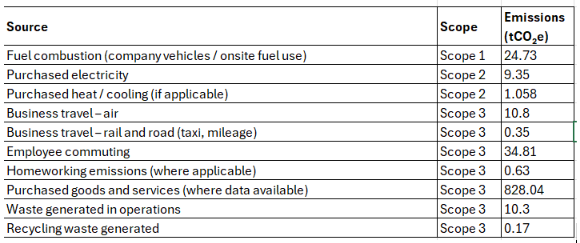
Total Baseline Emissions – 919.49 tCO₂e (annual total)
Current Emissions Table
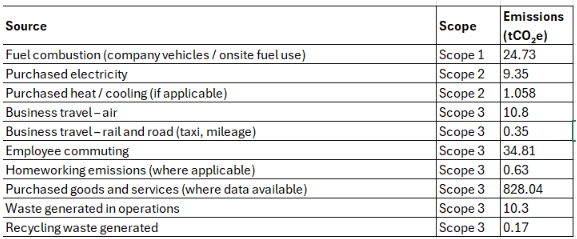
Total Current Emissions – 919.49 tCO₂e (annual total)
. Emissions Breakdown (Scope 1, 2 and 3)
- Scope 1 – Direct Emissions
Scope 1 emissions arise from direct sources owned or controlled by the organisation, including:
- Company vehicles (where applicable)
Scope 1 Total: 25.08 tCO₂
We are committed to reducing Scope 1 emissions through improved efficiency, behavioural change, and the transition to lower-emission operational practices where feasible.
- Scope 2 – Energy Indirect Emissions
Scope 2 emissions relate to purchased electricity used in our offices.
Scope 2 Total: 9.35 tCO₂e
We are committed to reducing Scope 2 emissions through:
- Improved energy efficiency across office environments
- Responsible energy consumption practices
- Ongoing review of energy sourcing options, including renewable alternatives where available
Scope 3 – Other Indirect Emissions
Scope 3 emissions include indirect emissions resulting from our value chain and business activities, including:
- Business travel (air, rail, and road)
- Employee commuting
- Homeworking where applicable
- Purchased goods and services (where data is available)
Upstream transportation and distribution
Not separately quantified in FY2025. Barclay Communications does not currently hold supplier delivery, courier, logistics, shipment weight, transport mode and distance data in a form that allows this category to be calculated separately with reasonable confidence. This will be treated as a data improvement area in future reporting cycles.
In parallel, Barclay Communications will seek to strengthen its supplier engagement approach by prioritising relationships with partners that demonstrate clear commitments to carbon reduction and net zero. By working more closely with suppliers who actively measure and reduce their emissions, the business aims to improve both the quality of data available for reporting and the overall carbon performance of its value chain over time.
Downstream transportation and distribution
Not separately quantified in FY2025. Barclay Communications does not currently hold customer dispatch, fulfilment, returns, courier, shipment weight, transport mode and distance data in a form that allows this category to be calculated separately with reasonable confidence. This will be treated as a data improvement area in future reporting cycles.
In parallel, Barclay Communications will seek to enhance its customer fulfilment and logistics approach by working with partners and service providers that demonstrate clear commitments to carbon reduction and net zero. By prioritising relationships with organisations that actively measure and manage their emissions, the business aims to improve both data visibility for future reporting and the overall carbon efficiency of its downstream logistics activities.
Scope 3 Total: 885.06 tCO₂e
We recognise Scope 3 as the most significant contributor to our overall carbon footprint and are committed to improving measurement accuracy and reducing emissions through practical operational changes.
Emissions Methodology
Emissions have been calculated using:
- UK Government DESNZ conversion factors
- GHG Protocol Corporate Accounting Standard
- Activity-based datasets (fuel, electricity, travel, spend, waste volumes)
Where primary data was unavailable, the following estimation methods were used:
- Spend-based EEIO (purchased goods)
- Headcount-based commuting model
- Journey-based business travel estimates
- Volume-to-weight waste conversion
All assumptions are documented and will be refined annually.
https://www.gov.uk/government/collections/government-conversion-factors-for-company-reporting
Carbon Reduction Strategy
We are implementing a structured carbon reduction programme aligned with ISO 14001.
Scope 1 Measures
- Consider transition to EV/hybrid fleet vehicles
- Reduction in fuel consumption through efficiency monitoring
- Optimisation of business travel requirements
Scope 2 Measures
- Energy efficiency improvements across office estate
- Reduced electricity consumption through behavioural change
- Review of renewable energy procurement options
Scope 3 Measures
- Reduced air travel through digital collaboration
- Sustainable commuting promotion (rail, bus, walking, cycling)
- Supplier engagement to improve emissions transparency
- Waste reduction and improved recycling segregation
- Improved procurement governance for Telecoms equipment
Carbon Reduction Targets & Net Zero Trajectory
Short Term (2026–2030)
- 20–30% reduction in total emissions
- Reduction in air travel emissions by 30%
- Transition majority of fleet to low-emission vehicles
- Improved Scope 3 data accuracy (commuting, suppliers, waste)
Medium Term (2030–2040)
- 40–55% reduction in total emissions
- Near-complete transition to EV/low-carbon fleet
- Increased renewable energy procurement
- Significant reduction in purchased goods emissions intensity
Long Term (2040–2050)
- Achieve Net Zero by 2050
- Residual emissions minimised and offset only where unavoidable
- Fully embedded low-carbon procurement and operations model
Residual Emissions and Carbon offsetting
Barclay Communications recognises that offsetting is not a substitute for emissions reduction. Where residual emissions remain after implementation of reduction initiatives, these may be balanced through high-quality, verified carbon offset schemes such as the UK Woodland Carbon Code, Gold Standard, or Verified Carbon Standard projects.
Any offsets purchased will be independently verified, additional, and transparently reported.
Completed and Ongoing Initiatives
ISO 14001 Environmental Management System certified and fully operational, providing a structured framework for managing environmental responsibilities, ensuring compliance obligations are met, and driving continual improvement in environmental performance through regular audits, objectives, and senior management review.
Full UK carbon baseline established across Scope 1, Scope 2, and relevant Scope 3 emissions, developed in line with UK Government (DESNZ) conversion factors and GHG Protocol methodology, forming the foundation for ongoing carbon reduction tracking and Net Zero planning.
Hybrid working model embedded across the organisation, enabling reduced commuting emissions, improved operational flexibility, and a measurable reduction in Scope 3 employee travel impacts while maintaining service delivery and productivity.
Initial consideration towards EV and hybrid fleet vehicles underway, supporting the gradual decarbonisation of Scope 1 transport emissions, with continued review of fleet composition to support long-term low-emission transport adoption.
Waste segregation and recycling systems implemented across operational sites, supporting improved diversion from landfill, increased recycling rates, and alignment with waste hierarchy principles (reduce, reuse, recycle), contributing to reduced Scope 3 waste emissions.
Electricity and fuel consumption monitoring systems in place, enabling more accurate tracking of Scope 1 and Scope 2 emissions, improving data quality, and supporting targeted efficiency initiatives and ongoing emissions reduction planning
Governance and Responsibility
Responsibility for this Carbon Reduction Plan sits with senior management and is governed through the ISO 14001 EMS framework.
We will:
- Review emissions annually
- Update reduction targets regularly
- Improve data quality each reporting cycle
- Track progress against Net Zero trajectory
ISO 14001 Environmental Management System
Our ISO 14001 certified EMS ensures:
- Identification and management of environmental impacts
- Continuous improvement in environmental performance
- Annual audit and management review cycle
- Senior leadership accountability
Declaration and Sign Off
This Carbon Reduction Plan has been completed in accordance with PPN 06/21 and the associated guidance and reporting standard for Carbon Reduction Plans.
Emissions have been reported and recorded in accordance with the published Carbon Reduction Plan reporting standard, the GHG Protocol Corporate Accounting Standard, and uses the appropriate UK Government Department for Energy Security and Net Zero (DESNZ) greenhouse gas conversion factors for company reporting.
Scope 1 and Scope 2 emissions have been reported in accordance with Streamlined Energy and Carbon Reporting (SECR) requirements. The required subset of Scope 3 emissions has been reported in accordance with the Carbon Reduction Plan reporting standard and the GHG Protocol Corporate Value Chain (Scope 3) Standard.
This Carbon Reduction Plan has been reviewed and approved by the Board of Directors (or equivalent senior management body) and uses appropriate Government and recognised third-party emission conversion factors for greenhouse gas reporting.
Approved by:
Name: John Britton Megahey
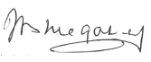
Position: Managing Director / Founder.
Date: Monday 26th January 2026